
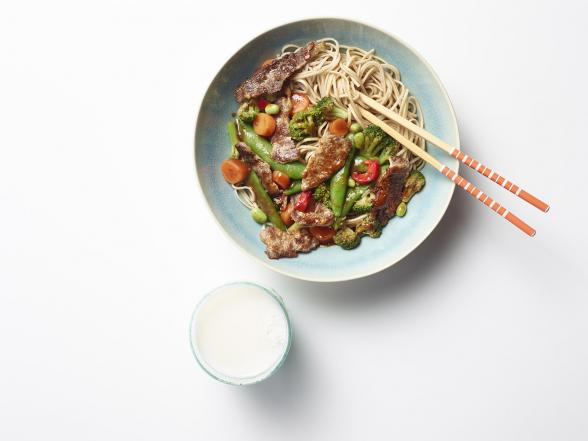
DASH (Dietary Approaches to Stop Hypertension) is a flexible and balanced eating plan that helps create a heart-healthy eating style for life. It was named “Best Heart-Healthy Diet” and “Best Diet for High Blood Pressure” by U.S. News & World Report in 2025.
Description of the DASH Eating Plan
The DASH eating plan requires no special foods and instead provides daily and weekly nutritional goals. This plan recommends:
- Eating vegetables, fruits, and whole grains
- Including fat-free or low-fat dairy products, fish, poultry, beans, nuts, and vegetable oils
- Limiting foods that are high in saturated fat, such as fatty meats, full-fat dairy products, and tropical oils such as coconut, palm kernel, and palm oils
- Limiting sugar-sweetened beverages and sweets
Based on these recommendations, the following table shows examples of daily and weekly servings that meet DASH eating plan targets for a 2,000-calorie-a-day diet.
| Food Group | Daily Servings |
|---|---|
| Grains | 6–8 |
| Meats, poultry, and fish | 6 or less |
| Vegetables | 4–5 |
| Fruit | 4–5 |
| Low-fat or fat-free dairy products | 2–3 |
| Fats and oils | 2–3 |
| Sodium | 2,300 mg* |
| Weekly Servings | |
| Nuts, seeds, dry beans, and peas | 4–5 |
| Sweets | 5 or less |
*1,500 milligrams (mg) sodium lowers blood pressure even further than 2,300 mg sodium daily.
When following the DASH eating plan, it is important to choose foods that are:
- Low in saturated and trans fats
- Rich in potassium, calcium, magnesium, fiber, and protein
- Lower in sodium
The number of servings you should have each day depends on your daily calorie needs. Use these worksheets to see how your current eating habits compare to DASH.
Calorie Needs
To figure out your calorie needs, you need to consider your age and physical activity level. If you want to maintain your current weight, you should eat only as many calories as you burn by being physically active. This is called energy balance. (For more information about energy balance, go to the Health Topics Overweight and Obesity article.)
If you need to lose weight, you should eat fewer calories than you burn or increase your activity level to burn more calories than you eat.
Consider your physical activity level. Are you sedentary, moderately active, or active?
- Sedentary means that you do only light physical activity as part of your typical daily routine.
- Moderately active means that you do physical activity equal to walking about 1.5 to 3 miles a day at 3 to 4 miles per hour, plus light physical activity.
- Active means that you do physical activity equal to walking more than 3 miles per day at 3 to 4 miles per hour, plus light physical activity.
Use the chart below to estimate your daily calorie needs.
Daily Calorie Needs for Women
| Age (years) | Calories Needed for Sedentary Activity Level | Calories Needed for Moderately Active Activity Level | Calories Needed for Active Activity Level |
|---|---|---|---|
| 19–30 | 2,000 | 2,000–2,200 | 2,400 |
| 31–50 | 1,800 | 2,000 | 2,200 |
| 51+ | 1,600 | 1,800 | 2,000–2,200 |
Daily Calorie Needs for Men
| Age (years) | Calories Needed for Sedentary Activity Level | Calories Needed for Moderately Active Activity Level | Calories Needed for Active Activity Level |
|---|---|---|---|
| 19–30 | 2,400 | 2,600–2,800 | 3,000 |
| 31–50 | 2,200 | 2,400–2,600 | 2,800–3,000 |
| 51+ | 2,000 | 2,200–2,400 | 2,400–2,800 |
After figuring out your daily calorie needs, go to the table below and find the closest calorie level to yours. This table estimates the number of servings from each food group that you should have. Serving quantities are per day, unless otherwise noted.
DASH Eating Plan—Number of Food Servings by Calorie Level
| Food Group | 1,200 Cal. | 1,400 Cal. | 1,600 Cal. | 1,800 Cal. | 2,000 Cal. | 2,600 Cal. | 3,100 Cal. |
|---|---|---|---|---|---|---|---|
| Grainsa | 4–5 | 5–6 | 6 | 6 | 6–8 | 10–11 | 12–13 |
| Vegetables | 3–4 | 3–4 | 3–4 | 4–5 | 4–5 | 5–6 | 6 |
| Fruits | 3–4 | 4 | 4 | 4–5 | 4–5 | 5–6 | 6 |
| Fat-free or low-fat dairy productsb | 2–3 | 2–3 | 2–3 | 2–3 | 2–3 | 3 | 3–4 |
| Lean meats, poultry, and fish | 3 or less | 3–4 or less | 3–4 or less | 6 or less | 6 or less | 6 or less | 6–9 |
| Nuts, seeds, and legumes | 3 per week | 3 per week | 3–4 per week | 4 per week | 4–5 per week | 1 | 1 |
| Fats and oilsc | 1 | 1 | 2 | 2–3 | 2–3 | 3 | 4 |
| Sweets and added sugars | 3 or less per week | 3 or less per week | 3 or less per week | 5 or less per week | 5 or less per week | ≤2 | ≤2 |
| Maximum sodium limitd | 2,300 mg/day | 2,300 mg/day | 2,300 mg/day | 2,300 mg/day | 2,300 mg/day | 2,300 mg/day | 2,300 mg/day |
a Whole grains are recommended for most grain servings as a good source of fiber and nutrients.
b For lactose intolerance, try either lactase enzyme pills with dairy products or lactose-free or lactose-reduced milk.
c Fat content changes the serving amount for fats and oils. For example, 1 Tbsp regular salad dressing = one serving; 1 Tbsp low-fat dressing = one-half serving; 1 Tbsp fat-free dressing = zero servings.
d The DASH eating plan has a sodium limit of either 2,300 mg or 1,500 mg per day.
DASH Eating Plan—Serving Sizes, Examples, and Significance
| Food Group | Serving Sizes | Examples and Notes | Significance of Each Food Group to the DASH Eating Plan |
|---|---|---|---|
| Grainsa | 1 slice bread1 oz dry cerealsb½ cup cooked rice, pasta, or cerealb | Whole-wheat bread and rolls, whole-wheat pasta, English muffin, pita bread, bagel, cereals, grits, oatmeal, brown rice, unsalted pretzels and popcorn | Major sources of energy and fiber |
| Vegetables | 1 cup raw leafy vegetable½ cup cut-up raw or cooked vegetable½ cup vegetable juice | Broccoli, carrots, collards, green beans, green peas, kale, lima beans, potatoes, spinach, squash, sweet potatoes, tomatoes | Rich sources of potassium, magnesium, and fiber |
| Fruits | 1 medium fruit¼ cup dried fruit½ cup fresh, frozen, or canned fruit½ cup fruit juice | Apples, apricots, bananas, dates, grapes, oranges, grapefruit, grapefruit juice, mangoes, melons, peaches, pineapples, raisins, strawberries, tangerines | Important sources of potassium, magnesium, and fiber |
| Fat-free or low-fat dairy productsc | 1 cup milk or yogurt1½ oz cheese | Fat-free milk or buttermilk; fat-free, low-fat, or reduced-fat cheese; fat-free/low-fat regular or frozen yogurt | Major sources of calcium and protein |
| Lean meats, poultry, and fish | 1 oz cooked meats, poultry, or fish1 egg | Select only lean; trim away visible fats; broil, roast, or poach; remove skin from poultry | Rich sources of protein and magnesium |
| Nuts, seeds, and legumes | ⅓ cup or 1½ oz nuts2 Tbsp peanut butter2 Tbsp or ½ oz seeds½ cup cooked legumes (dried beans, peas) | Almonds, filberts, mixed nuts, peanuts, walnuts, sunflower seeds, peanut butter, kidney beans, lentils, split peas | Rich sources of energy, magnesium, protein, and fiber |
| Fats and oilsd | 1 tsp soft margarine1 tsp vegetable oil1 Tbsp mayonnaise2 Tbsp salad dressing | Soft margarine, vegetable oil (canola, corn, olive, safflower), low-fat mayonnaise, light salad dressing | The DASH study had 27% of calories as fat, including fat in or added to foods |
| Sweets and added sugars | 1 Tbsp sugar1 Tbsp jelly or jam½ cup sorbet, gelatin dessert1 cup lemonade | Fruit-flavored gelatin, fruit punch, hard candy, jelly, maple syrup, sorbet and ices, sugar | Sweets should be low in fat |
a Whole grains are recommended for most grain servings as a good source of fiber and nutrients.
b Serving sizes vary between ½ cup and 1¼ cups, depending on cereal type. Check the product’s Nutrition Facts label.
c For lactose intolerance, try either lactase enzyme pills with dairy products or lactose-free or lactose-reduced milk.
d Fat content changes the serving amount for fats and oils. For example, 1 Tbsp regular salad dressing = one serving; 1 Tbsp low-fat dressing = one-half serving; 1 Tbsp fat-free dressing = zero servings.